At the World Journal of Environmental Biosciences, we follow a double-blind peer review process from start to finish: authors never find out who reviewed their work, and reviewers never learn whose manuscript they're evaluating. We hold firmly to this approach because we believe true objectivity is only possible when a manuscript is judged purely on its scientific merit — not on an author's name, institution, or reputation. This careful, multi-stage process is what keeps everything we publish fair, credible, and scientifically sound.
To be considered at all, a manuscript must be original: it can't be under review anywhere else, and it must never have been published before in any form. Every stage — submission, review, and production — takes place through a secure online platform, keeping the process transparent and traceable for everyone involved.
The Review Process
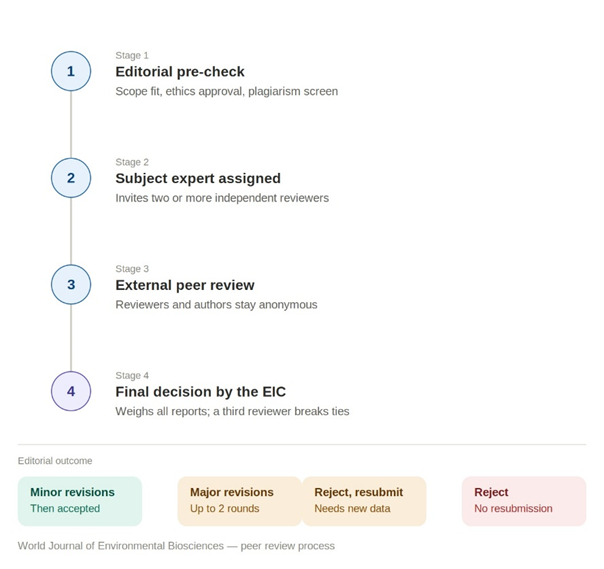
1. Initial Editorial Check
As soon as a manuscript comes in, the Editor-in-Chief (or an Associate Editor assigned to the task) runs a preliminary evaluation. This covers three things: whether the manuscript fits the journal's scope, whether it meets ethical research standards (including proper approvals and documented informed consent), and an initial plagiarism check. Manuscripts that fall short on any of these are desk-rejected at this point, without moving on to full peer review.
2. Assigning a Subject Expert
Manuscripts that pass the initial check are handed to an Associate Editor (or International Editor) whose expertise matches the topic. This editor takes a closer look at the study's methodology and scientific grounding. Their job goes beyond simply confirming the manuscript fits — they're also responsible for finding and inviting at least two independent external reviewers with expertise closely matching the paper's specific subject.
3. External Peer Review
At this stage, at least two independent reviewers assess the manuscript from multiple angles: scientific quality, methodological soundness, originality, and clarity of presentation. Each reviewer sends their report and recommendation directly to the Associate Editor and the Editor-in-Chief. Throughout this stage, the identities of both reviewers and authors stay strictly confidential.
4. Final Decision
The Editor-in-Chief weighs the Associate Editor's recommendation alongside the detailed external reviewer reports to reach a final decision. Acceptance requires at least two favorable reviews. If reviewers disagree — say, one recommends acceptance and another recommends rejection — a third independent expert is brought in to settle it. A decision made on the basis of a single review is reserved for rare cases where finding a second qualified reviewer genuinely isn't possible (this happens in fewer than 5% of all reviewed submissions), and any such decision must be fully documented and justified by the Editor-in-Chief.
Editorial Decisions and Revisions
Depending on the outcome of review, a manuscript follows one of four paths:
Accept after Minor Revisions: Authors are asked to address all reviewer comments within a set timeframe.
Reconsider after Major Revisions: Authors must respond point-by-point to every reviewer comment. As a general rule, up to two rounds of substantial revision are allowed.
Reject with Encouragement to Resubmit: Manuscripts that need significant additional experiments or data are declined in their current form, with an invitation to resubmit as a new manuscript once that work is complete.
Reject: Manuscripts with serious scientific flaws, major ethical breaches, or no original contribution are rejected outright, with no option to resubmit.
One point worth stressing: every reviewer comment, without exception, needs to be addressed individually and in full. If authors disagree with a reviewer's critique, they're expected to explain why clearly and with sound reasoning in their response letter — simply stating disagreement isn't enough.
Review Timeline and Complaints
Timeline: The review process typically takes one to two months, depending on how quickly reviewers respond and how complex the manuscript is.
Complaints: We're committed to handling every complaint fairly and constructively. Authors who wish to appeal an editorial decision can reach out to the Editor-in-Chief directly. Complaints about journal policies, procedures, or editorial conduct are acknowledged within six working days, with progress updates shared every two weeks until the matter is resolved. The Editor-in-Chief's ruling on any complaint is final.
Become a Reviewer
If you're a qualified expert interested in contributing as a peer reviewer, we'd love to hear from you. Just reach out to our editorial team at:
 This work is licensed under a Creative Commons Attribution 4.0 International License.